Eugene Owen R Griffin (1875-1955)
Bridget Delia Kelliher (1878-1955)
This page has been created with the input of Meghan Hurlburt, a great-great granddaughter of Owen & Delia.
Bridget Delia Kelliher was born on 19 Jan 1872 in Glounagillagh, a farming area about 7km from Killorglin, Co Kerry (although their farm was at Muingaphuca, one or two kilometers away). Her parents were Patrick Kelliher & Mary [O’]Neill.

When Patrick Kelliher died in 1895 Bridget was just 17 and an orphan, as her mother Mary had passed away before her father. On 24 Apr 1896 she sailed on the S.S. Pavonia to Boston with a Timothy Kelliher (aged 22). Timothy was her first cousin: Patrick had a brother Timothy Kelliher who inherited Patrick’s holding on his death, and Timothy had a son [John] Timothy, born in 1874. Their destination on embarking was (it appears, the writing is not very clear) a cousin named Murphy (click the following to view a larger image):

On the same ticket were a John O’Brien (aged 26) and a Minnie O’Brien (aged 28) from Brookhill, some 6km south-east of Killorglin. Bridget arrived back in Queenstown on the Saxonia in Jan 1901, returning by 31 Mar (the date of the 1901 census) to work for John Murphy’s family in Killorglin.
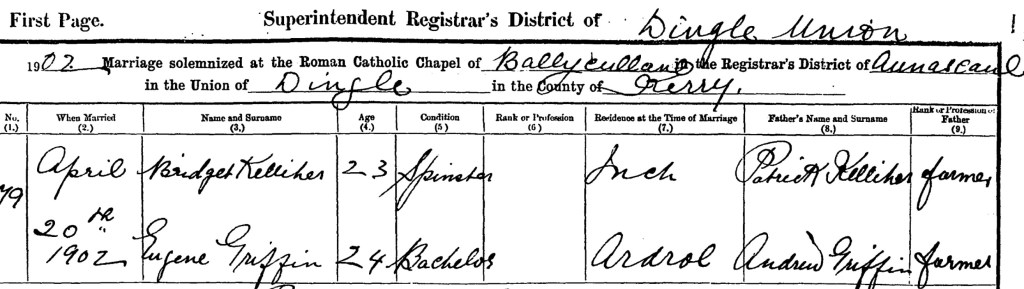
Bridget married Eugene Owen Griffin, a farmer at Annascaul on the Dingle Peninsula, on 20 Apr 1902:
On 04 Nov 1910 Bridget arrived in New York on her way to Boston to visit her half-sister Ellen Dowling; this is the first evidence we have of a sister, and the first evidence we have that Bridget also went by the name Delia, a name she used within family circles. Ellen would have been Patrick’s daughter from his first marriage as she gives her birth year as 1863 on the record of her second marriage.
Click to view a larger image of Delia’s arrival record:

page 2:

Owen & Delia had five children together:
01. Vincent DePaul (b. 02 Feb 1903, d. 06 Feb 1978 in Boston)
02. Mary (b. 27 Jan 1905, d. 15 Mar 1981 in Boston)
03. Francis Patrick (b. 23 Feb 1907, d. 01 Jan 1973 in Boston)
04. Celia G. (b. 24 May 1913, d. 17 Feb 1998 in Boston)
05. Eugene Columbus (b. 29 Jul 1916, d. 10 Mar 1955)
All four older children migrated to Boston while Eugene remained at home in Inch, Annascaul, with his parents. His life and the lives of his parents ended very tragically;, when Eugene Jn. shot his parents before setting fire to the house and shooting himself. This is the report from The Kerryman on Sat 09 Apr 1955 on the of the Coroner’s findings:
INQUEST STORY OF GRIM TRIPLE TRAGEDY AT INCH
That in his opinion the deaths in all three cases occurred before the fire became extensive, Dr. Maurice Hickey, State Pathologist, said at the resume inquest at Inch on Wednesday on eighty years’ old Owen Griffin, his 75 years’ old wife, Bridget, and their 38 years’ old son, Eugene, whose charred remains were discovered in their burned out home at Ardroe, Inch, on Wednesday, March 9.
Dr Hickey told the Coroner, Dr. D. Sheehan, and the jury that the cause of death in each was gunshot wounds. He said that Mrs. Griffin had been shot in the back and that the father had been shot twice, and in both cases the shots could not have been self-inflicted.
The verdict returned by the jury was that Owen and Bridget Griffin died from gunshot wounds and that their son died of gunshot wounds self-inflicted.
Mr. D. E. Brown, State Solicitor, appeared for the authorities.
Mr. J. C. Guihan, solr. Tralee, appeared for the next-of-kin, Francis Griffin, of 1004 Hyde Park Avenue, Hyde Park, Mass, Vincent Griffin, 12 Estey Street, Roxbury, Mass, and Mrs. Mary Short, 31 Church St, Boston, and Mrs. Celia Forde, 66 Calamut Street, Roxbury, Mass, (sons and daughters of Owen and Bridget Griffin).
Chief Supt. P. Connolly, Tralee, Supt. M. O’Leary, Dingle, Inspector P. Lonergan, Tralee, and Sergt. O’Connor, Tralee, as well as Garda officers from Dublin were present during the proceedings.
Sergt. Patrick Cronin, Dingle, produced a sketch of the house which he had prepared. It was a two-story house. There were four rooms on the ground floor and a corridor from the front door to the rear door. Upstairs there were three rooms.
One of the bodies was found lying on a dividing wall between the corridor and a room at the back of the house, and the two other bodies were found a short distance from the front door in the corridor on the ground floor.
In the course of a search in the corridor near the front door they found a complete set of metal trousers braces. They searched at the rear where the other body, believed to be that of Eugene Griffin, was found and they did not find any metal parts there. He was told that as a rule Eugene did not wear braces, while the old man did.
CARTRIDGE BASES FOUND
Portion of a gun was found on the ground floor. Two cartridge bases were found, one between the door and fireplace in the kitchen and the other in the corridor.
Two lamps were found in the kitchen – a stove lamp and portion of a standard
lamp. Several cartridge cases were found – about 33 cases in all – were found
scattered over a floor in a room. The percussion caps of these were blown out
and one or two showed that they had not been fired out of a gun.
In the dwelling-house, after the fire, they found parts of the shotgun. They found locks and bolts. They found a Yale lock with the tongue in the locked
portion at the front door. They also found two bolts, one of which was fully
shot home – locked permanently – and the other partly shot home. Six rim locks
and four keys were found in the debris. They found two primus stoves, both of
which were badly damaged. Two half-crowns were found near the front door.
Dr. Maurice Hickey, State Pathologist, said that on Friday, March 11, he
performed a post mortem examination on three bodies, which had been removed
from the burnt house.
For the purpose of evidence he would, he said, describe the bodies by
number. Body number 1 had been identified to him as having been found
immediately inside the front door of the house. It was a body of a female over
the age of 60 years.
The bones of the face and front of the skull, the front of the chest and abdomen, and both hands and feet had been burned away.
EXTENSIVELY CHARRED
The remainder of the body was extensively charred. The front of the lungs was charred.
No sooty material was found in the air tubes of the lungs.
There was a shotgun wound present in the back in the middle line of the back two inches below the level of the hips.
He found part of a shotgun cartridge embedded in the tissues in the back of the wound.
The charge had fractured the lower portion of the spine.
Pellets of shot were mingled with the fragments of the broken bone.
The direction of the charge was forward and slightly downwards across the abdomen and the point of exit was indicated by fracture of the pelvis or hip bone slightly to the left of its middle position.
All but the back of the skull had been burnt away. A semi-circular notch was present on the edge of the right side of the remaining portion of the skull. This was probably caused by a second shot wound.
“In my opinion” said Dr, Hickey, “the cause of death was one or more shotgun wounds. I conclude from the age and sex of the body that this was presumably that of Mrs. Griffin, and that the shotgun wound in the back could not have been self-inflicted, and that owing to the absence of sooty material in the air tubes that death occurred before the fire became extensive.”
BODY No. 2
Continuing, Dr. Hickey said that body No. 2 was identified as having been found on the floor of the back ground room. It was the body of a male under 50 years of age.
The entire body surface was extensively charred. The top of the skull, the left hand and both feet had been burned away.The bones of the face were charred and brittle.
He found no sooty material in the windpipe or air tubes of the lung. He found two irregular wounds, approximately two inches in diameter, slightly behind the middle line of the left side of the chest.
The lower of these was about eight inches below the arm pit and tghe other about three inches higher up the chest.
Pellets of shot were present in the chest wall above and behind the upper of these wounds.
Pellets were also present up to approximately one inch from the edge of the wound.
Some pellets had not penetrated the inner line of the chest wall, indicating that this was an entry wound, the direction of which was upwards and slightly forwards, tearing the outer side of the lung to a three-inch circular wound to the upper portion of the chest. This wound was below the collar bone and extended inwards to the left side of the breast bone.
There was nothing to indicate that the deceased was alive when the fire got under way.
CAUSE OF DEATH
He concluded that death was due to a shotgun wound in the chest prior to the fire getting extensively under way.
From its sex and age this body was presumably that of Eugene Griffin junior. The shotgun wound in the left side of the body could have been self-inflicted. The size of the wound and the absence of the wad and greater part of the charge of the shot suggested that the shot was fired with the muzzle of the gun close to the body.
The spread of the shot which was found at one side of the entry wound might appear to contradict this suggestion. The spread of the shot could only be observed in the deeper layers of the chest wall as the surface skin and muscles had been burned away.
The spread was confined to an area above and behind the edges of the wound and was probably due to a few grains of shot being deflected from the main charge by a rib which crossed the upper edge of the wound.
A shot from so close to the body was therefore probable. The lower wound in the side of the body could be result of the fire. There were no signs to indicate that it was a second shot wound.
BODY No. 3
Giving evidence about body number 3, Dr. Hickey said it was that of a male and was found inside the front doorway of the house.
The entire head, right arm, both feet, front and right side of the chest and front of the abdomen had been burned away.
The reminder of the body was extensively charred. The front of the lungs were charged. He found no sooty material in the air tubes. He found two separate portions of shotgun cartridge wads behind the right lung.Bleeding had occurred below the muscle sheet which separated the chest and abdomen.
The entire cartridge wad and some pellets were present between the stomach and diaphragm.
The direction of the shot was across the front of the body from the right side. The charge had torn the upper left surface of the lung and made a wound 1¾ inches in diameter in the left side of the diaphragm and towards the lower end and front of the heart. Pellets were present in the chest cavity.
This body was so extremely damaged that the estimate of the age could not be made. From its sex and by exclusion he presumed it was the body of Eugene Griffin senior. As two shots had been fired into the body it is unlikely that the wounds were self-inflicted. In his opinion death was due to shotgun wounds in the chest and abdomen.
Concluding, Dr. Hickey said that in in opinion death had occurred in all three cases before the fire got extensively under way.
TWO SHOTS FIRED
Detective-Sergt. P. J. Murphy, Ballistics expert, Civic Guard Headquarters, said that the presence of cartridge wads in body number 3 (which was presumed to be that of Owen Griffin) indicated that two shots were fired at him. He received parts of a 12 bore double-barrel shotgun of the Hammersmith type. A fired 12 bore cartridge case was found in the right chamber. There was no striker for the left barrel. Of 22 brass cartridge cases sent to him, the caps were missing from 20. This was due to the cartridges having exploded during the intensive heat.
The position of the wounds on the body of the young man was consistent with the deceased while standing having placed the gun at his left side with the stock on the ground and holding the barrel with his left hand and having the muzzle close to his chest, then having pressed the trigger with a stick held in his right hand.
“Bearing in mind the very acute angle the line of fire makes with the body also the limited spread of shot as described by Dr. Hickey, I am of the opinion that the shooting of this person in a manner other than that described, is extremely remote, if not impossible” said Sergt. Murphy, who also stated that he had come to the conclusion that the gunshot wound in the young man was self-inflicted.
Sergt. Murphy then produced a shotgun of the same make as the one found in Griffin’s house, and demonstrated how it was possible for a person to shoot oneself with it.
He placed the stock of the gun on the ground with the barrel pressed against his left side and held in position with his left hand. It was, he said, a hammerless gun, and he told the jury that before one pulled the trigger they had to press forward the safety catch.
Then taking a stick in his right hand Sergt. Murphy struck the trigger with it and there was a click as it was released.
“As you can see the angle is very acute and if the man was shot by an assailant it would be impossible to get that angle” Sergt. Murphy told the jury when he pointed out to them the position of the wound in the body.
SIGNIFICANT FACT
“I am satisfied,” he said, “that it could be ruled out that he was shot by another. It is a significant fact that the head of the gun coincides with the entrance wound. For that reason, I have come to the conclusion that the would on the young man was self-inflicted.
Replying to the foreman of the jury, Sergt. Murphy said that the one barrel of the gun was not in a position to discharge a shot because the striker was missing.
William J. Edwards, firearms dealer, Tralee, gave evidence of a number of purchases of cartridges made by the Griffins from him since 1945. He had sold them cartridges in December 1953.
Guard Cors. Lenihan, Annascaul, said that after receiving a telephone message at 1.30 p.m., that the Griffin house was on fire, he and his sergeant proceeded there immediately , arriving there about 1.50 p. m.
The heat was so intense it was not possible to go closer than three to five yards of the dwelling. The sergeant went to the Post Office to summon the Fire Brigade, and when he returned he informed witness that he had made inquiries about the Griffins, and that in his opinion they were in the building.
Witness then suggested they look at the farmyard to see if the cattle had been foddered. They had to force open the cow-house door because there was dung against it.
The cattle appeared to be hungry and not attended to and this satisfied them that the Griffins were in the house.
The people who were present then were also satisfied that the Griffins were in the fire.
Some time afterwards they saw a body lying on its stomach and suspended on a dividing wall.
BEYOND RECOGNITION
When they were able to get into the house, witness and a member of the fire brigade brought out the body which was burned beyond recognition. It was a body of a male.
They next found parts of a shotgun.
Later, a body was found about four feet inside the front door in the hall. This lady was also burned beyond recognition. The third body was also found beside this one.
Continuing, Guard Lenihan said the Griffins had a farm of about 17 acres, which was very poorly managed. They were not progressive farmers.
Mrs. Ellen Moriarty said she knew Owen Griffin and his wife and son. She also knew Owen Griffin’s father, Andy Griffin. Many years ago when there were evictionsat Inch, Andy Griffin was waylaid at Glenagalt when returning from Tralee. He was not very good after that and was sent to the Mental Hospital and never left it.
Owen Griffin had two brothers, both of whom died in the Mental Hospital.
Mrs. Mary O’Donnell, a cousin of the Griffins, said, she remembered the brothers who died in the Mental Hospital.
Sergt. Timothy Leahy, Annascaul, said that when he arrived at Inch on March 8 about 1.40 p.m. flames and smoke were shooting up through the roof in the front portion of the house.
When he returned from the post office after telephoning for the fire brigade, the roof was falling in in bits and scraps.
He looked in the hallway from the front and saw a body balanced on a dividing wall.
Continuing, Sergt. Leahy said that the family were in poor circumstances and they were in debt to the amount of £50. There were shop debts. There was a sum of £10 owed to the builder for the erection of the house.
Inquiries showed that the family had no money in the post office or banks.
The gun was the property of Owen Griffin and he held it under a £2 certificate.
A witness from the Technical Bureau, Guarda Headquarters, said that a gent’s Raleigh bicycle, which he examined, was in very bad repair.
SMOKE FROM THE HOUSE
William Bowler said that on March 9 his son told him at dinner time that smoke was coming from Griffin’s house. He went to the scene and realised it was on fire. He went to the front door, knocked and called “Owen” twice, but did not get an answer. He kicked the door but got no answer. He then went around the back of the house and, as he passed the window, he noticed flames inside. The back door was locked and he called out again, but got no answer. He forced the door open and saw that the stairs was in flames. He ran across the hall to try to get into the kitchen but he could see nothing but smoke. He called out again but got no answer. This was about ten minutes past one.
Thirty or forty years ago Griffin, senr., attempted to commit suicide by drowning, and witness and another man had to tie a rope around him and drag him home.
James O’Donnell said he was driving in a County Council lorry on March 6 and as they approached Inch they noticed fire in Griffin’s house. They went to the house and found that the front door was locked. One of the persons with him forced it open.
“HAD THREATENED HIM”
John Curran said that one time after Shrove when he was having a conversation with Mr. Griffin, senr., he asked him why he did not let Eugene get married and he said would hold on to the place for another while. He also told witness at that time that Eugene had threatened him the previous night with a gun.
Joseph Bowler said that on March 8 he was drawing sand for the County Council from the strand. He passed Griffin’s house about 8.30 a.m. but did not see any smoke.
Later that morning he saw smoke coming out through the slates. He also noticed that the glass in the windows was black with smoke. He did not see any smoke going up the chimney. He told his father about what he had seen.
KICKED IN DOOR
Mr. Doherty, Ballbrack, Farranfore, Co. Council lorry driver, said he noticed smoke coming from Griffin’s house about 1.30 or 1.40 p.m. He stopped the lorry outside the house and he and the occupants went to the front door which was locked. He gave the door a few kicks and drove it in. The door was locked on the inside.
Jeremiah Buckley, whom was with the last witness, corroborated his evidence.
DRINKING HEAVIER THAN USUAL
Maurice Kennedy, who said he was a pal of Eugene Griffin’s, said that on the night prior to the fire he gave him a turnscrew. He identified the remains of the turnscrew presented to him as the one he had given the deceased.
There was no electricity in Griffin’s house and they used oil lamps for lighting. It was a table lamp which would be hung, but was usually left on the table. When going to bed Mrs. Griffin usually used a storm lamp or candle.
As far as he could remember, the gun was always kept in a corner in the kitchen.
At that time, Eugene was drinking heavier than he normally drank, but he did not notice anything unusual about his conduct.
One day, Eugene told him he was going to England, but he did not give any reason for going.
Eugene frequented the hotels in summer time and he kept a pony which he hired out to the tourists. He used to be friendly with the tourists and he used to be around with a girl from England, but he never mentioned anything about her to witness.
Mr. Brien said that on the morning of March 9 his sheep were in Griffin’s land and he went in there and turned them out around 8 a.m. He was about 20 yards from the house but did not notice anything strange or unusual about it. There was no smoke at that time.
STATE SOLICITOR’S SUBMISSIONS
The evidence having been completed, Mr. D.E. Browne, State Solicitor, who represented the Authorities, addressing the jury submitted that it was abundantly clear from the evidence that Mr. Griffin, senior and his wife, met their deaths at the hands of their son and that they were both murdered by their son. Furthermore, it was his submission, he said, that the son died of gunshot wounds which he inflicted on himself – in other words suicide. That, he submitted, was the verdict which they must bring in on the evidence.
THIS PAGE IS UNDER DEVELOPMENT
 ONeillfamily